Twenty years that look like scatter — and weren't.

Photography. An agency. Video. Brand systems. Hardware validation at Intel. On a résumé that reads as someone who couldn't settle. Read in order, it's one thing being learned repeatedly: how to tell whether the thing in front of you is any good.

These chapters overlap — the businesses ran alongside the agency, the photography never really stopped, and the day job started while the rest was still going. So this is ordered as an argument rather than a strict chronology.

Every one of them ends the same way, and that repetition is the point.

Throughout

Half a dozen businesses, starting with a lawnmower

Landscaping first, then a string of others, up through photography and the agency. Some worked, some taught me what doesn't. All of them meant the same loop: work out what somebody actually wants, build the thing, charge for it, and find out immediately whether you were right.

Running your own business is the fastest available education in being wrong. There's no department to absorb it. The market tells you, in money, within weeks.

The deposit: knowing the difference between what people say they want and what they'll pay for — and being unsentimental about which one you built.
The agency years

A boutique ad agency, and the layer I never got tired of

I built clientele, ran the work, and did every part of it — but the layer I loved was always conceptual direction. Not the execution: the idea that makes the execution obvious. Get that right and everything downstream stops being guesswork.

The clearest case was an air show pilot in his first two years, up against the marketing departments of Red Bull, Oracle and the major oil companies — every one of them with a sponsored pilot and a real budget. I was the entire department: identity, photography, video, print, booth, collateral, web. We placed 2nd and 3rd in consecutive years in the International Council of Air Shows (ICAS) Marketing Competition.

One hand across every surface produces a coherence a committee structurally can't. Their identity went through brand guardians and sign-off chains. Ours went through one person at every touchpoint, so nothing drifted. The shoestring didn't win despite being one person — it won partly because of it.

The first ceremony was a dinner in a ballroom on the last day of ICAS Vegas. I stepped out to the bathroom, and that's when they announced it. I came back to the table and Jon was sitting there with an enormous grin, so I asked him what was funny. He got to be the one who told me.

  • Jon Melby Airshows — the full case study Identity, air-to-air photography, the campaign film, the booth and the website — every surface, alone. It lives on the Creative door, where there is room to read it.
The deposit: directing creative from the idea down, and evidence that judgment can beat budget when it's the same judgment all the way through.
From 1997

Photography — where all of it actually started

My first creative role was shooting weddings in 1997. Then portraiture, editorial, commercial, studio. Eventually a self-published coffee-table book, which meant the photography, the marketing, the print production and the writing were all mine — my first taste of owning every surface of a thing rather than one slice of it.

Weddings in particular teach something no studio can: one take, no reshoot, and a client who will look at those images for fifty years. You learn to see the shot before it happens, and to know instantly whether you got it.

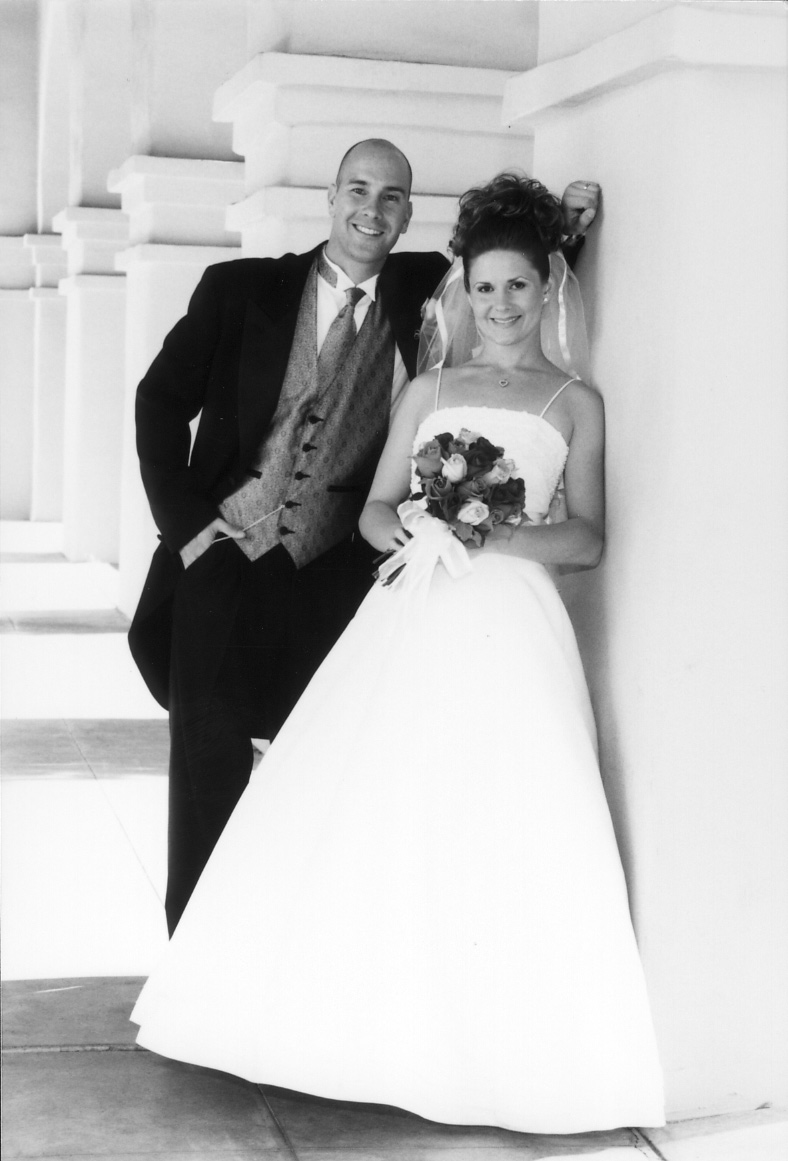
A black-and-white wedding portrait: the couple stand full-length against white columns, the bride in a full ball gown holding a bouquet, the groom in morning dress.
Full length against the columns, high-key, the gown carrying the frame. One take, no reshoot — and a client who will look at it for fifty years. That is the discipline this chapter is about: see the shot before it happens, and know instantly whether you got it.
⏳ Book spreads in preparation.
The deposit: the trained eye. Not I like thisthis one is better, and here's why. That's the muscle everything since has run on.
The eye, in motion

Video — story with a clock running

The eye carried over, but moving image adds the thing a photograph never has to solve: time. Order, pace, what you withhold and for how long. I write the story and cut the production, and I hold a Part 107 for the aerial work.

It's also the discipline that maps most directly onto directing AI video now — the models have made generation cheap, and left every hard problem exactly where it was. Consistency, continuity, whether a cut earns its place.

⏳ Reel in preparation.
The deposit: storytelling with a clock running — and knowing which ninety seconds of four hours are the ones worth keeping.
Alongside all of it

Design and brand — the systems underneath

Identity, type, color, layout — and the rules that hold them together across surfaces that never sit side by side. A logo is the easy part. The hard part is a system coherent enough that someone else could extend it without asking you.

That's the same skill as writing an operating contract for an AI build: you're not making the artifact, you're making the thing that decides what the artifact should be.

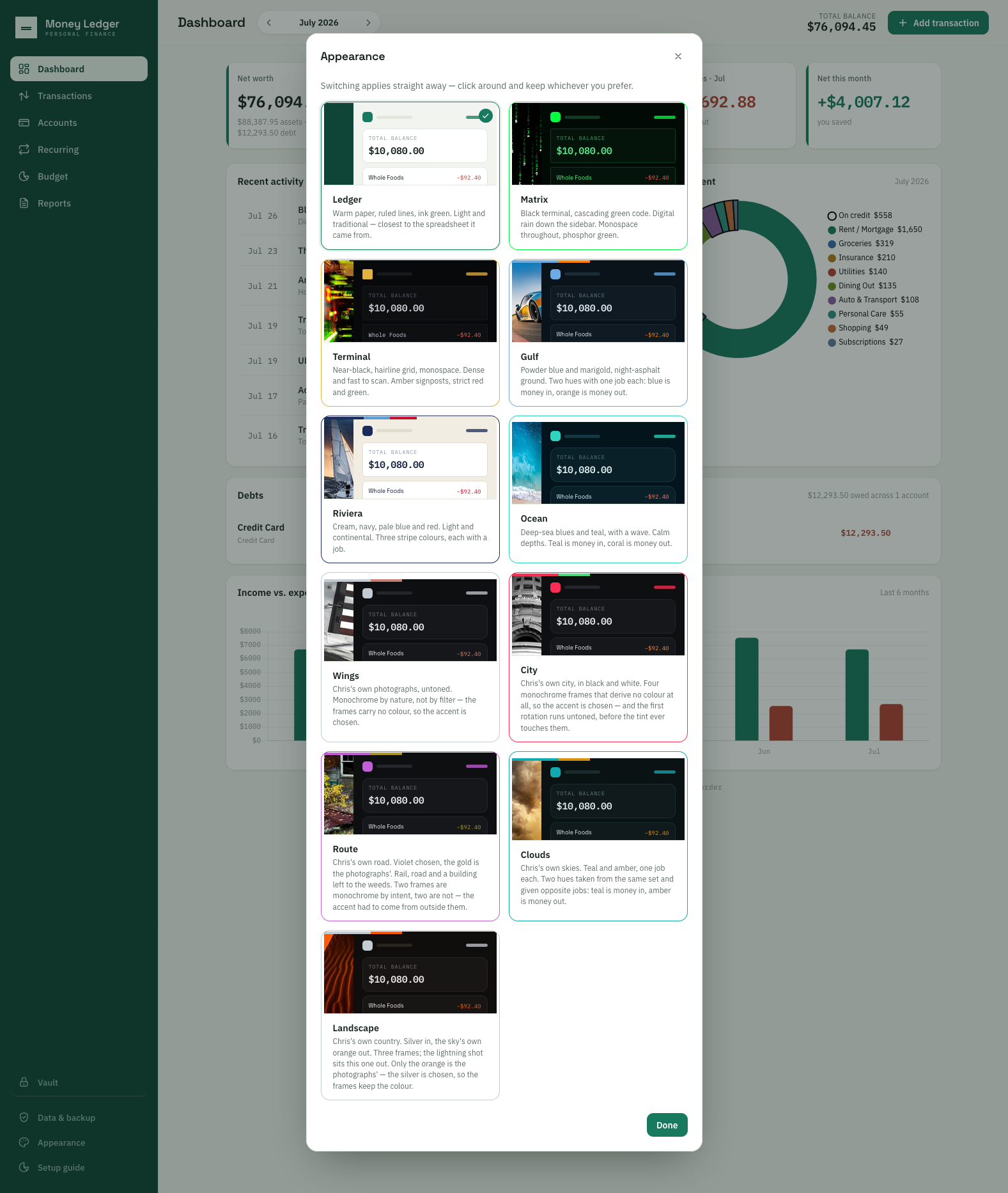
The MoneyLedger theme picker: eleven selectable themes shown as a grid of preview cards, each restyling the whole application while the layout and controls stay identical.
Eleven themes in one product. Not eleven skins — eleven applications of one set of rules, each restyling every surface while the layout, the controls and the typographic hierarchy hold. Some are photographs I took; some are art-directed generations. That is the same claim twice over — a system coherent enough to extend, and the direction of an AI to fill it without the system coming apart.
The deposit: systems thinking with taste attached — consistency as a design decision rather than an accident.
Intel · 1998–2000, and 2019 — present

The one that doesn't fit

Six chapters in, this is the one that looks like it wandered in from someone else's résumé. It didn't. It was here first.

From 1998 to 2000 I designed, built and maintained Intel's internal web sites — back when the way you got that job was being the person who had already worked out how. Then two decades of everything above: the agency, the cameras, the businesses, the brand systems.

I came back in 2019, this time validating silicon and server hardware — processors, motherboards, the occasional PCIe card. No cameras, no clients, no concepts. Something has been designed and built, and before it goes near a customer, somebody determines whether it actually does what it claims. Before the org restructured I led that team: seven reports, and I did the hiring.

Here's the part that belongs in this timeline. In 2021 the lab had a problem nobody owned: over a thousand pieces of pre-production silicon across several labs and hundreds of trays, with no tracking and no tray identity. Finding a part meant looking by hand — thirty minutes on a normal day, an hour for anything that hadn't moved in a while.

Nobody asked me to fix it. I got tired of spending thirty minutes a pop looking for silicon. So I designed a coding system that gave every tray and product a real identity, built a web database on top of it, and the hand-search became a lookup. At peak, one program alone ran two pieces of silicon per board across a couple of hundred test systems. It's still what the lab uses, five years on.

Read that with the rest of this page in mind, because it's the same sentence every time. The renovation suite: nothing tied design to cost to permits, so I built one. The finance app: I wanted my money private and mine, and nobody makes that. The lab: I was tired of looking for silicon. See the missing tool, build the missing tool.

The other half of this job is what it taught me about being unimpressed. “It ran without errors” is not “it's correct.” The defect that kills you is never the loud one — it's the plausible one, the confident wrong number on a document that looks finished.

The deposit: judgment as a paid discipline — and proof the builder's instinct predates AI making construction cheap.

Now

It converges

So when I say I build products with AI, understand what I mean by build. I set the architecture, the design language, and an operating contract the work has to hold to — then I direct the AI against it and reject what doesn't clear the bar. That last part is most of the job, and it's the part the tools don't do for you.

Screenshotting my own apps for this portfolio should have been a capture session. Twice it became a review pass instead. Both times an automated audit had just run clean — 344 assertions green on the second one — and a person still found seven defects no test could have caught, because not one of them was a calculation. A permit document counting a garage as living space. Every expense in a ledger signed +. Setup deleting records silently and then reporting success.

AI made producing things nearly free, so the whole game moved to knowing which output to keep. Every chapter above was practice for that, and none of them knew it at the time.

And it closes where it opened. In 1998 I was building web software at Intel. Twenty years of cameras, clients and concepts in between — the part that supposedly doesn't belong on a technical résumé. I'm back at the same company, directing software again, and the twenty years are the reason I'm any good at it.

Nobody changed careers. The two halves just took a while to arrive at the same place.

The deposit: all of them, spent at once.
The products, in depth →

Twenty years wasn't scatter. It was one long apprenticeship in judgment.

And judgment is the one thing AI can't supply itself. It will make you a thousand options and have no opinion about which one is right. That part is still a person's job — and it's the job I've been training for since 1997 without knowing what it was for.

Get in touch Product Creative